A job sheet that talks to the ERP
The job sheet was the only paper process in a computerised operation. It's now digital, designed for tablets first, and connected to the ERP to pull in customers and parts and send back a job sheet ready for invoicing.
Around twenty job sheets a day, filled in by hand. It was the only manual process in an operation that was otherwise computerised: customers and the tyre catalogue were in the ERP, quotes were printed from it, but the sheet that goes with the car was still on paper, and the time spent on each job was lost.
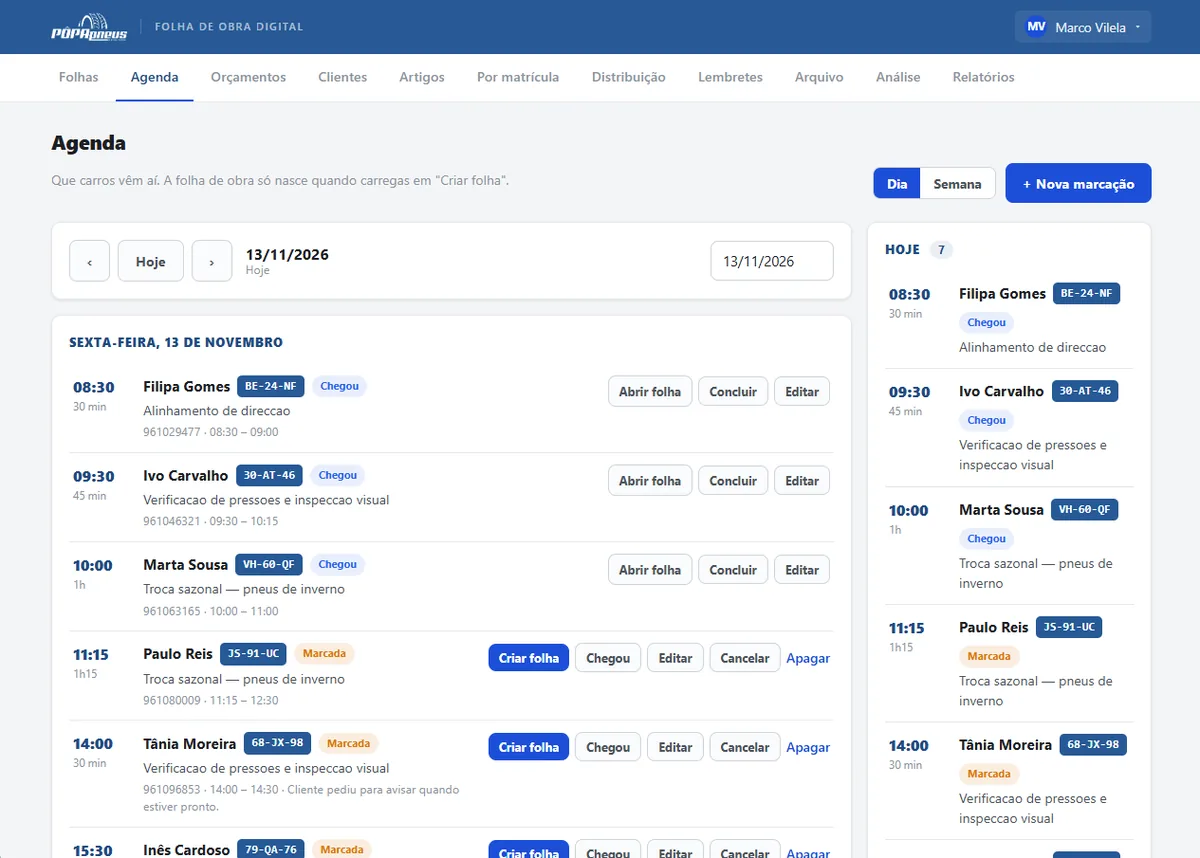
A digital job sheet designed for tablets, faithful to the form the team already used, connected to eticadata to pull in customers and parts. History by number plate, time tracking per job, a searchable archive and tyre replacement reminders.
Job sheets are no longer filled in by hand: they're created in the system with the data already in the ERP, closed as a record and, when the garage decides, sent on for invoicing. A car's history by number plate is now one search away.
The starting point
Pôpa Pneus is a tyre fitting and car servicing centre in Torres Vedras. When we first spoke, almost all of the operation was already computerised: customers and catalogue in the ERP, printed quotes. The exception was the job sheet: around twenty a day, filled in by hand and then copied out neatly.
Their paper job sheet was well thought out: time in and time out, number plate, make, model and mileage, a checklist of services, the materials used by tyre type with size and pressure, and a safety checklist. The system’s specification was practically already written. The job wasn’t to invent a new process, it was to respect that one and take the paper out of it.
The digital job sheet
The digital job sheet was designed for tablets and follows the original form field by field. The customer and parts come from eticadata, so nobody has to type in again what is already in the system. At the end, the sheet closes as a record, and turning it into an invoice is an explicit decision by the garage, sheet by sheet, because not every job needs an invoice.
What paper never allowed
Around that came the things paper never allowed: the history by number plate, to see at a glance what has already been done to that car; time tracking per job, which simply didn’t exist on paper; a searchable archive by number plate, customer or number, with export; and a queue of replacement reminders, which turns the history into a reason for the customer to come back.
Having the feature isn’t having the solution
There’s one detail of this project worth telling, because it happens in a lot of businesses: the ERP actually had a job sheet module, and it had never been used. Having the feature isn’t the same as having the solution. What was missing was a tool that someone in the workshop, with dirty hands, would rather use than a biro. That’s the test that matters.
Got a similar process?
Tell me how it works today. The first conversation costs nothing — and I tell you straight whether it is worth doing.