An association website whose dates you can trust
A new website for CO.JO.PE — weekly activities, the institution, official documents and membership — with news and campaigns that appear and disappear on their own, on the agreed date.
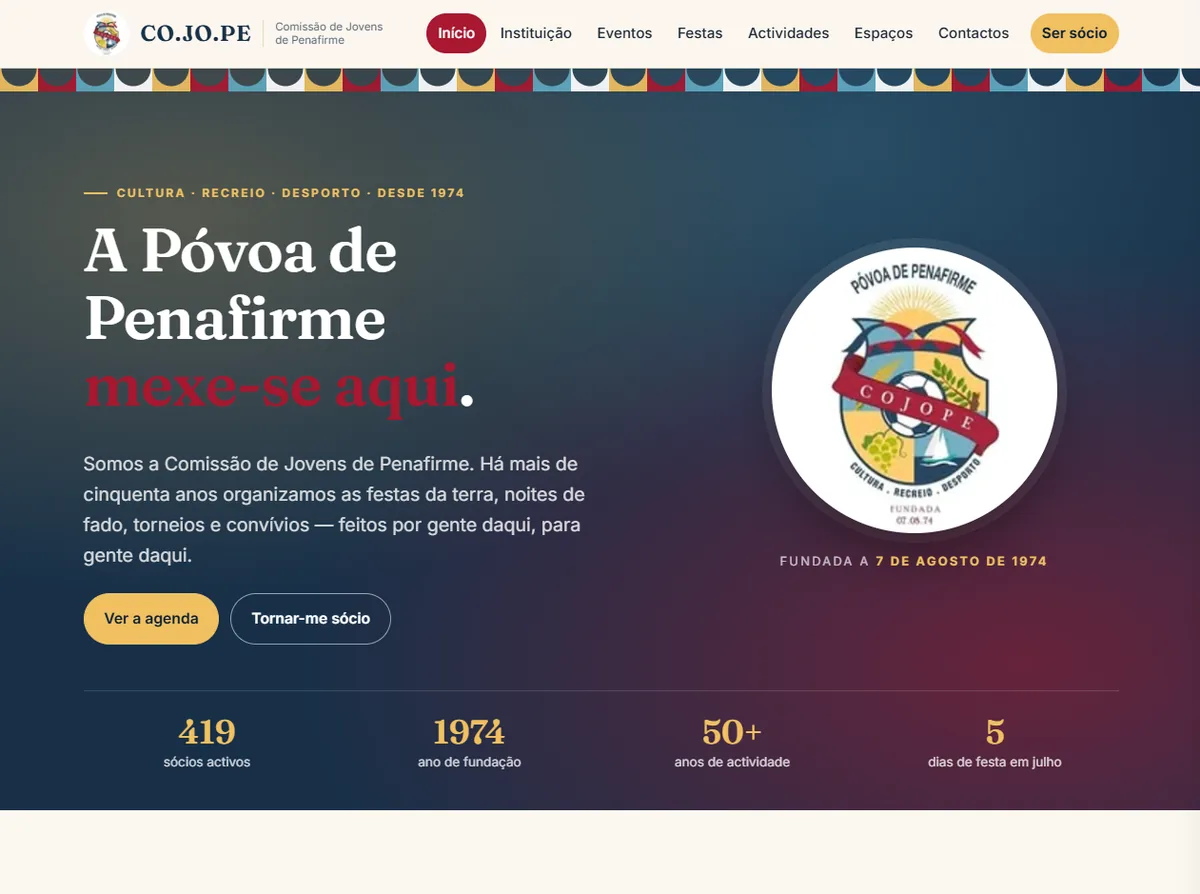
An association with 419 active members and classes every week has information that changes constantly, and information that must not go out early. A news item published a day ahead of schedule is not a formatting slip: it is a broken commitment to the board, and in a volunteer-run organisation that costs more than an ugly website.
A static site built with Astro, with every activity, news item and document in its own file. Anything dated obeys its date: an item set for the 1st does not exist on the 31st, and a campaign with an end date disappears without anyone having to remember to remove it.
Live at cojope.pt, with domain email working and the statutes, minutes and audit committee opinion available to any member. The board asks for corrections and they go in the same day.
The association
CO.JO.PE has been running since 1974 in Póvoa de Penafirme, on the Portuguese west coast. It has 419 active members, an office with set opening hours, and classes all week long: table tennis, outdoor activities, fitness, Sevillanas dancing, yoga and a senior sports programme run jointly with the local council.
It was the first association to reply to my free-website campaign, and so the first to graduate from a mock-up into a real project.
A site that respects dates
What sets a site like this apart from a company’s is its relationship with time. An association runs in seasons: the festival is in August, enrolment opens on one date, a public vote closes on another. And there is a detail you only grasp once you work with a board: some things must not appear ahead of time. Not for marketing reasons, but out of respect for an internal process — sometimes a members’ meeting, sometimes a public body’s deadline.
That became clear halfway through the project, with the municipality’s participatory budget. The association entered the 10th edition with an indoor lift to reach the first floor, costed at €23,500, and voting ran from 1 to 31 October by free text message. I built the news item with the voting instructions, a banner across every page and the poster as a PDF, all with a start and end date. And in testing I found a real problem: news items were not actually filtering by date, which meant the participatory budget piece would have gone live on the next deploy — days early, and against an explicit request from the board.
The fix was not to paper over that one case. It became a rule of the site that a future-dated item generates no page at all — it is not tucked away in a corner waiting to be found by a search engine, it simply does not exist until the day. It is the kind of decision nobody notices when it is right, and that earns you an unpleasant conversation when it is wrong.
Built with the board
The rest of the site grew with the board dictating the content. The activities page lists each class with its schedule and the instructor’s direct contact, because that is the question that reaches the office. The institution page carries the history and both the current and previous boards, in photographs and text. And there is an official documents area with the statutes, the 2024 amendment, the publication in the national gazette, the internal rules, the audit committee’s opinion and the membership form — which in an association with hundreds of members is not bureaucracy but real transparency, reachable without having to ask anyone.
One round of corrections says a lot about how this should work: the board noticed that two officers’ roles had been swapped and that a member was missing from an earlier board. Both were fixed the same day. An institutional website that takes a week to correct a treasurer’s name ends up not being corrected at all.
Result
The menu was cut down to six entries with a prominent “Become a member” button, and domain email is receiving. Live at cojope.pt.
Got a similar process?
Tell me how it works today. The first conversation costs nothing — and I tell you straight whether it is worth doing.