An association website the association can keep up to date itself
A new website for ACRO (services, native breeds, events and official notices), built so the association can add and correct content without relying on anyone.
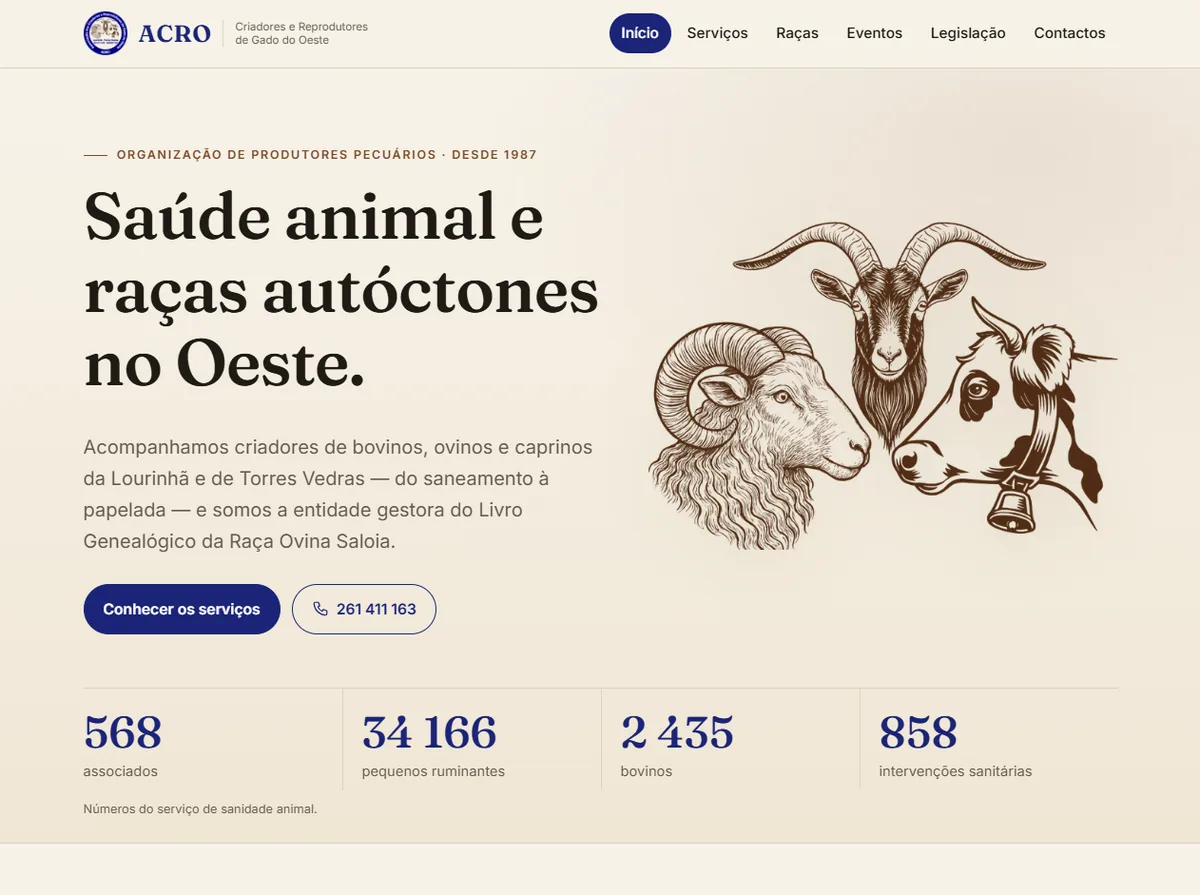
An association with 568 breeders across two municipalities runs on information that keeps changing: notices from DGAV (the national food and veterinary authority), IFAP subsidy application deadlines, event dates. It has no technical staff. A website that needs a developer to change a date is dead on arrival, and no breeder goes back to it.
A static website built with Astro, with all the content in plain text files: services, breeds, events and documents. Fast on a phone, accessible, and with events moving on their own from upcoming to past as the date goes by.
The site is live at acro.pt. The association adds a new event or notice without calling me, and three people from ACRO have left five-star reviews on Google.
The association
ACRO (the Association of Livestock Breeders of the Oeste region, north of Lisbon) was founded in 1987 and supports cattle, sheep and goat breeders in Lourinhã and Torres Vedras. It handles disease eradication programmes, veterinary support, IFAP subsidy applications, farm licensing and transport. It is also the body that keeps the herd book for the Saloia sheep, a native Portuguese breed now classed as endangered.
In numbers: 568 members, more than 34,000 sheep and goats, 2,435 cattle. Two offices, the same team.
The real problem is upkeep
For an organisation like this, the hard part of a website isn’t the design. It’s keeping it up to date. The information a breeder needs changes every month: DGAV publishes a new notice on bluetongue, an application window opens, a livestock show is scheduled. If each of those changes means phoning someone, it doesn’t get done. And a website with a two-year-old notice on the front page is worse than no website at all: it teaches the breeder not to come back.
Everything in text files
So the decision that shaped the project was this: all the content lives in text files. The seven services, the two breeds, the events and the documents are in Markdown and YAML, one file per item. Adding an event means creating a file with the title, dates, location and poster. Adding a notice means adding four lines to a list. Nobody needs to know how to code, and there’s no admin panel to forget the password to.
Built for people in the field
Everything else followed the same idea of keeping things easy. Events move on their own from “upcoming” to “past” as the date goes by, without anyone having to tidy them up. The site is static, which means it opens quickly on a weak connection, and many of these breeders look at it on their phone, out in the fields. Both offices, with phone numbers and opening hours, are one tap away on every page, because the most common question to an association like this is still “when are you open and where are you?”.
Result
It’s live at acro.pt. It’s a different project from most of what I do (it doesn’t take anyone off paper and it doesn’t connect to an ERP), but the principle is the same as in the others: a tool is only useful if the people who work there can use it without me.
Got a similar process?
Tell me how it works today. The first conversation costs nothing — and I tell you straight whether it is worth doing.